How to Evaluate Fruit Purées and Concentrates: Sensory Profile, Specification and Application Testing

Updated: Jul 21
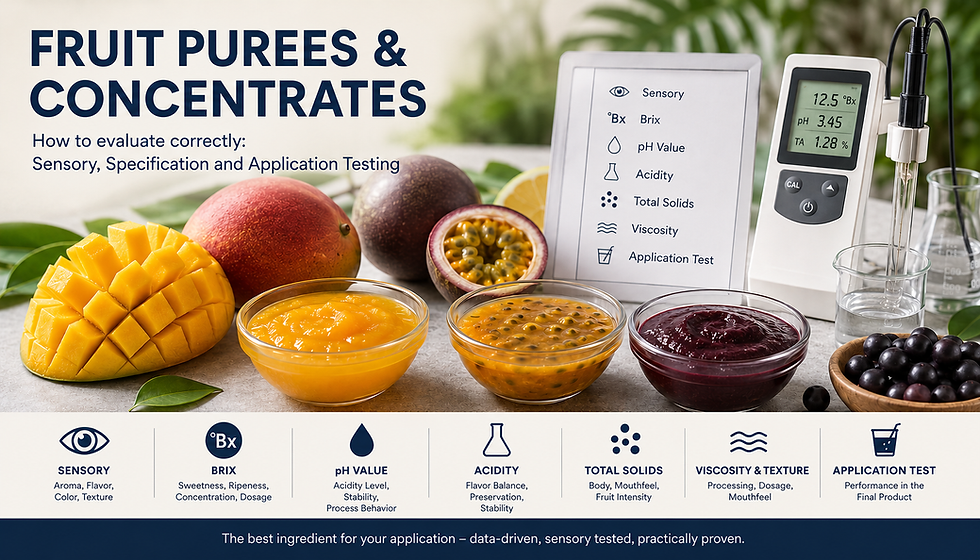
Evaluating fruit purées and concentrates: what really matters
Tropical fruit ingredients are often evaluated first by taste, colour and origin. For industrial applications, however, sensory evaluation alone is not enough. Whether a fruit purée or concentrate is truly suitable for an application only becomes clear when sensory profile, product specification, processing behaviour and application testing are considered together.
For purchasing, product development and quality management teams, one key question is therefore essential: How should a fruit ingredient be evaluated professionally – and which parameters really matter?
1. Understand the product format: purée is not concentrate
The first step in any evaluation is to clearly understand the product format. Fruit purées and concentrates can both be high-quality ingredients, but they fulfil different functions.
Fruit purées and polpas typically contain fruit pulp, natural colour, aroma and the texture of the respective fruit. They are particularly suitable for applications where authentic fruit character, mouthfeel and natural sensory profile are important – such as smoothies, sorbets, ice cream, desserts, fruit preparations or foodservice.
Concentrates are more focused on efficiency, dosage, storage and process stability. They can be useful when intense fruit flavour, acidity, colour or fruit content needs to be added at a lower dosage. From a sensory perspective, however, they often differ from purées, as texture, freshness and fruit pulp character may be less pronounced depending on the product format.
A mango purée can provide body, natural sweetness and mouthfeel in a smoothie. A mango concentrate, on the other hand, can be an efficient way to add fruit character and sweetness to a beverage. With passion fruit, a purée can deliver natural freshness and fruit character, while a concentrate may be used primarily as an aromatic and acidity-providing component.
The key question is therefore not: Which is better? It is: Which product format fits the specific application?
2. Sensory evaluation: more than “it tastes good”
Sensory evaluation is an important part of ingredient assessment, but it should be done in a structured way. The decisive point is not only whether a fruit ingredient tastes pleasant, but how it behaves in the context of a specific application.
Several aspects should be assessed separately: colour, aroma, taste, texture and aftertaste.
The colour should be typical, stable and suitable for the intended application. The aroma should appear fresh, ripe and characteristic of the fruit. Taste evaluation should consider the balance between sweetness, acidity, bitterness and possible astringent notes. Texture shows whether the product is smooth, fibrous, creamy, thick or watery. Aftertaste also matters: does a natural fruit impression remain, or do unwanted notes appear?
These differences are especially important with tropical fruits. Mango can be ripe, round and creamy – or thin, fibrous or cooked. Passion fruit can be fresh and aromatic – or too acidic, sharp or unbalanced. Açaí can stand out through colour, texture and total solids – or appear watery and sensorially weak.
For concentrates, it is also important not to evaluate the product only in its pure form. Many concentrates are not designed to be tasted directly. They should be tested in a defined dilution or directly in the target application. Only then does it become clear whether aroma, acidity, colour and balance really work.
3. Brix, pH value, acidity and total solids: what the values really mean
When discussing fruit purées and concentrates, Brix is often the first value mentioned. The Brix value indicates the level of soluble solids in a product, mainly sugars. In practice, Brix is important because it helps assess sweetness, ripeness, concentration level, dosage and comparability between batches.
In a fruit purée, Brix helps to classify the sweetness and intensity of a fruit base. In concentrates, the value is particularly relevant because it is closely linked to concentration level, dilution and reconstitution. A concentrate with a higher Brix value will be dosed differently from a purée with natural fruit content.
However, Brix is not a complete quality indicator. Two products with similar Brix values can perform very differently from a sensory perspective. A mango purée with good ripeness can taste much fuller and rounder at a comparable Brix level than a product with weaker aroma. With passion fruit, a product with moderate Brix can appear more intense due to a strong acidity and aroma profile than a sweeter but flatter product.
The pH value describes how acidic a product is from a chemical perspective. This is important for taste, microbiological stability, processing and interaction with other ingredients. Especially in dairy, dessert or protein-based applications, pH can be decisive, as too much acidity may lead to instability, flocculation or unwanted changes in texture.
Titratable acidity complements the pH value. While pH describes chemical acidity intensity, titratable acidity indicates how much acid is actually present in the product and how it affects sensory perception and technological behaviour. Two products can have a similar pH value but taste very different due to different acidity profiles.
Total solids describe, in simplified terms, how much substance other than water is present in the product. This is particularly relevant for texture, mouthfeel, fruit body and dosage. A product with higher total solids can provide more body and fruit intensity in smoothies, bowls, sorbets, ice cream or desserts. A purée that is too watery can quickly appear weak in the application, even if it tastes pleasant on its own.
This point is especially important for açaí. Different qualities can vary significantly in total solids, texture and application profile. An açaí quality for bowls often requires more body and structure than a version mainly used in beverages or smoothies.
Professional product evaluation therefore means not looking at Brix, pH value, acidity and total solids in isolation, but assessing them together with sensory profile and application.
4. Viscosity, texture and particle structure: critical for application performance
In addition to classic laboratory values, physical properties also play an important role. Viscosity describes how thick or fluid a product is. For R&D and production teams, this is relevant because viscosity influences dosage, pumpability, mixing behaviour, mouthfeel and processing.
A thick mango purée can be desirable in a smoothie or dessert because it provides body and creaminess. In a beverage, the same viscosity may be problematic if the product feels too heavy, mixes poorly or causes sedimentation.
Texture and particle structure are also important. Natural fibres, fruit pulp or small particles can be positive in smoothies, bowls or sorbets because they communicate naturalness and fruit character. In clearer beverages, fine desserts or industrial fillings, however, too much fibre structure can be disruptive.
For concentrates, the focus is different. Natural texture is less important; solubility, dosage, reconstitution and behaviour in the formulation matter more. A concentrate must integrate cleanly and should not cause unwanted effects in colour, sedimentation, taste or stability.
Colour is another important evaluation factor. It can provide indications of ripeness, processing, oxidation and batch consistency. In mango, a full natural colour is part of perceived quality. In açaí, dark colour is a central feature for positioning and application. In passion fruit, colour can also visually support freshness and intensity.
A fruit ingredient must therefore not only taste good. It must also be technically suitable for processing and perform reliably in the final product.
5. Practical example: evaluating a mango-passion fruit concept
A practical example shows what professional evaluation can look like. Suppose a manufacturer is developing a tropical beverage or smoothie concept with mango and passion fruit. The goal is a product with full fruitiness, clear tropical aroma, pleasant freshness and stable quality.
The first step is to define the product format. Mango could be used as a purée to provide body, natural sweetness and mouthfeel. Alternatively, a mango concentrate could be suitable if dosage, cost structure and process stability are the priorities. With passion fruit, the same question arises from a different perspective: purée for natural freshness and fruit character, or concentrate for intense acidity and aroma at a lower dosage.
Next comes sensory evaluation. The mango purée is assessed to determine whether it tastes ripe, round and fruity, or rather thin, cooked or fibrous. With passion fruit, the acidity is evaluated: is it fresh and aromatic, or sharp, bitter and unbalanced?
The specifications are then reviewed. Brix helps classify sweetness, ripeness and dosage. pH value and titratable acidity show how strongly acidity affects the product technologically and sensorially. Total solids and viscosity indicate how much body and mouthfeel the ingredient contributes to the formulation.
Only the application test reveals which combination truly works. Mango purée can provide more body and naturalness in the final beverage, while mango concentrate may be more efficient to dose but contribute less mouthfeel. Passion fruit purée can deliver a fresh, natural profile, while passion fruit concentrate can efficiently add acidity and aroma, but must be dosed precisely.
One possible solution could be to use mango purée as the base for body and natural fruitiness, while using passion fruit concentrate as a targeted aromatic acidity component. In a premium smoothie concept, however, a combination of mango purée and passion fruit purée may be more suitable if naturalness, texture and fruit character are the main priorities.
This example shows that the best solution does not come from a single value such as Brix, nor from tasting the product on its own. What matters is the interaction between product format, sensory profile, specification, dosage, application and the desired positioning of the final product.
6. Evaluation from three perspectives: R&D, purchasing and quality
A professional ingredient evaluation combines three perspectives.
R&D focuses on sensory profile, texture, colour, dosage and behaviour in the formulation. Purchasing evaluates price, availability, minimum order quantity, packaging, supply model and planning reliability. Quality management reviews specifications, certifications, microbiological criteria, traceability, processing and cold chain.
Only when all three perspectives align is a fruit ingredient suitable for long-term industrial use.
A product can be excellent from a sensory perspective but impractical from a logistics point of view. It can be attractive in price but perform poorly in the application. Or it can be technically well specified but not fit the desired product concept from a sensory perspective.
Professional evaluation therefore always means considering sensory profile, specification, application and sourcing together.
Conclusion
Fruit purées and concentrates should not be evaluated only by taste or price. For industrial applications, several factors matter at the same time: product format, sensory profile, Brix, pH value, acidity, total solids, texture, application testing, quality and supply reliability.
Brix is important – but it is not the whole story. Only in combination with pH value, acidity, total solids, sensory profile and application does it become clear whether a fruit ingredient truly fits the formulation.
For purchasing, product development and quality management teams, the decisive question is therefore not only: “Is this product good?” It is: “Is this product the right solution for our specific application?”
Eurobras supports European B2B customers in the selection and sourcing of Brazilian fruit purées, concentrates, açaí products and other tropical ingredients – with a focus on application, specification, quality and reliable sourcing.
Are you evaluating fruit purées or concentrates for a specific application?
Eurobras supports B2B customers in the selection and sourcing of Brazilian fruit purées, concentrates, açaí products and other tropical ingredients – tailored to application, specification, packaging and supply model.


Comments