Fruit Purée, Concentrate or Combination: Which Product Form Fits Which Application?


Tropical fruit ingredients can be used in many different product forms: as fruit purée, polpa, concentrate, sorbet base or foodservice solution. For purchasing, product development and quality management teams, the key question is therefore not only which fruit is interesting, but above all: Which product form fits the specific application?
A fruit purée is not automatically better than a concentrate. A concentrate is not automatically the more efficient solution. And in many industrial formulations, a combination of different product forms can be particularly effective.
The decisive factor is not the product alone, but its function in the final application.
1. Understanding the product form: purée is not concentrate
The first step is to clearly understand the product form. Fruit purées and concentrates can both be high-quality ingredients, but they fulfil different functions.
In simple terms: a fruit purée is processed fruit in a form that remains as close as possible to the original fruit – usually with fruit pulp, natural colour, aroma, texture and the natural water content of the fruit. It reflects the fruit relatively directly from both a sensory and structural perspective.
A concentrate, on the other hand, is produced when part of the water is removed from a juice or fruit base. This concentrates soluble components such as sugars, acids, colour and aroma. Concentrates are therefore more compact, more intense and more efficient to dose, but depending on the product they often provide less fruit body and natural texture than a purée.
Fruit purées and polpas are particularly suitable for applications where authentic fruit character, mouthfeel and natural sensory profile are important – such as smoothies, sorbets, ice cream, desserts, fruit preparations or foodservice.
Concentrates are more focused on efficiency, dosage, storage and process stability. They can be useful when fruit flavour, acidity, colour or fruit content needs to be added at a lower dosage. From a sensory perspective, however, they often differ from purées, as texture, freshness and fruit pulp character may be less pronounced depending on the product form.
A mango purée can provide body, natural sweetness and mouthfeel in a smoothie. A mango concentrate can be an efficient way to add fruit character and sweetness to a beverage. With passion fruit, a purée can deliver natural freshness and fruit character, while a concentrate may be used primarily as an aromatic and acidity-providing component.
The key question is therefore not: Which is better? It is: Which product form fits the specific application?
2. When fruit purée is particularly suitable
Fruit purée is often the right choice when the final product is strongly positioned around naturalness, fruit body, texture and authentic taste. Typical applications include:
smoothies and smoothie bases
bowls
sorbets and ice cream
desserts and dairy applications
fruit preparations
foodservice concepts
premium or clean-label products
In these applications, aroma is only one part of the equation. Mouthfeel, colour, viscosity and fruit pulp character also play an important role.
A mango purée can provide fullness and creaminess in a smoothie. Açaí purée can bring colour, texture and clear product positioning to bowls. Coconut purée can provide creaminess, structure or a mild tropical base, depending on the application.
Fruit purée is therefore particularly strong when the fruit should be visible, noticeable or sensorially central in the final product.
3. When concentrate can be the better solution
Concentrates are especially relevant when efficiency, dosing accuracy and process logic are key priorities. In many industrial applications, they can help add fruit character, colour, sweetness or acidity in a targeted way. Typical applications include:
beverages and RTD products
industrial blends
fruit preparations with a clear cost structure
formulations requiring high dosing accuracy
applications where texture is less important
products focused on process stability and standardisation
A passion fruit concentrate can provide freshness and acidity very efficiently in a beverage. A mango concentrate can help control sweetness and fruit character in a targeted way. In both cases, however, it is important not to evaluate the concentrate only in isolation, but in the intended dilution or directly in the target formulation.
Concentrate is particularly useful when the fruit ingredient is expected to fulfil a precise technological or sensory function, without fruit body and natural texture being the main focus.
4. When the combination is strongest
In industrial product development, the best solution is often not either purée or concentrate, but a combination.
Purée can provide body, texture and natural sensory profile. Concentrate can enhance aroma, acidity, colour or intensity in a targeted way. This allows formulations to be adapted more precisely to application, cost structure and the desired flavour profile:
Mango purée + passion fruit concentrate Mango provides body and sweetness, while passion fruit brings freshness and acidity.
Coconut purée + fruit concentrate Coconut provides creaminess or a mild base, while a fruit concentrate adds aromatic accents.
Açaí purée + additional fruit ingredients Açaí provides colour, texture and positioning, while other fruits can add sweetness, acidity or freshness.
These combinations show that product development is rarely a simple either-or decision. What matters is the sensory and functional role that each ingredient plays in the final product.
5. The most important decision criteria
When choosing between fruit purée, concentrate or a combination, purchasing and R&D teams should answer several questions together.
What is the intended application? A beverage has different requirements from a smoothie, sorbet, dairy dessert or foodservice product.
What role should the fruit play? Main flavour, accent, acidity provider, colour, texture, sweetness or positioning?
How important is texture? If fruit body, mouthfeel and natural structure are decisive, purée often has clear advantages. If texture is less important, concentrate may be suitable.
How precise does dosing need to be? Concentrates can offer advantages when low dosage, standardisation or process control are important.
What declaration and positioning are desired? A premium smoothie, an industrial beverage and a foodservice sorbet can have very different requirements in terms of fruit content, naturalness and product form.
What does the product form mean for logistics and cost? Packaging, storage, cold chain, minimum quantities, transport and yield all influence the commercial evaluation.
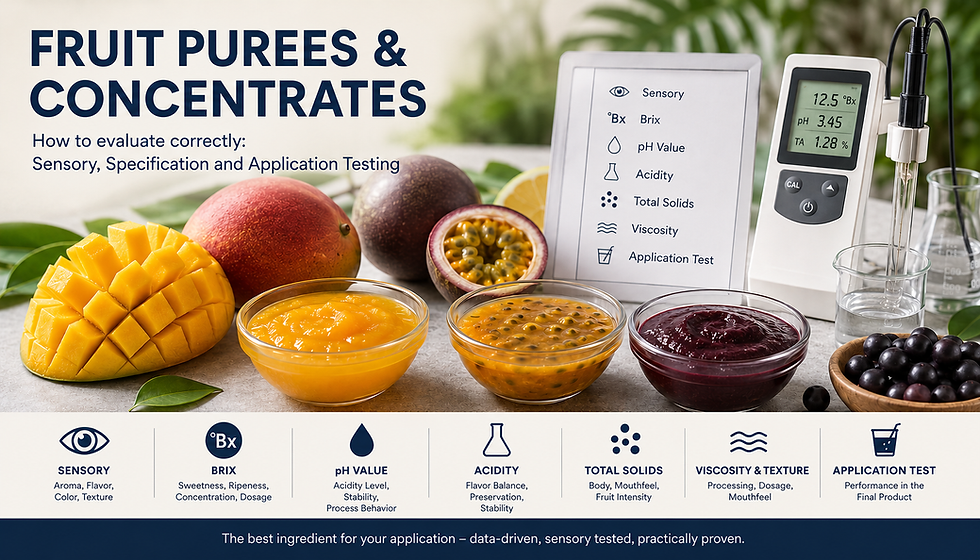
Does the ingredient work in the final product? The final decision should always be based on application testing – not only on specification or tasting the product on its own.
Conclusion
Fruit purée, concentrate and combined solutions each have their place. The right choice does not depend on a general product assessment, but on the specific application.
Fruit purées are strong when natural sensory profile, texture, fruit body and premium positioning are important. Concentrates can offer advantages when efficiency, dosing, acidity, colour or process stability are decisive. Combinations make it possible to connect the strengths of both approaches.
For purchasing, R&D and quality management teams, the key question is therefore not: Which product form is better?It is: Which product form fulfils the desired function in the final product most reliably?
Eurobras supports European B2B customers in the selection and sourcing of Brazilian fruit purées, concentrates, açaí products and other tropical ingredients – with a focus on application, specification, quality and reliable sourcing.
Are you evaluating fruit purée, concentrate or a combined solution?
Eurobras supports B2B customers in the selection and sourcing of Brazilian fruit purées, concentrates, açaí products and other tropical ingredients – tailored to application, specification, packaging and supply model.


Comments